Where WhatsApp Pay is today
WhatsApp Pay did about 168 million UPI transactions in July 2026. That is more than double of last year. It is now the 8th biggest UPI app.
But in the same month PhonePe did 10.85 billion and Google Pay did 7.64 billion. So WhatsApp is still less than 1% of UPI.
WhatsApp has more than 600 million users in India. So reach is not the problem. The problem is that people don't think of WhatsApp when they want to pay.
A lot has been written on this. Most of it is obvious, like give cashback and push QR codes. Here are 10 things I think are less obvious, and that only WhatsApp can really do.
10 ideas worth pursuing
1. Collect money in groups. Society maintenance, school trips, kitty parties, office lunch. All of this is already planned on WhatsApp groups. But the money gets paid on some other app. Let the group admin post a simple card: "₹500 each". Members tap and pay. Everyone can see who has paid and who hasn't. Nobody wants to be the one who hasn't paid. That will bring in more new users than any cashback. (NPCI has stopped P2P collect requests, so the member has to start the payment. The card does exactly that.)
2. Let family pay for each other. NPCI has UPI Circle. My mother can pay from my account and I approve it. Very few people use it, because it sits inside a payments app my mother is not using. The family WhatsApp group is the right place for it. Mom pays the chemist, I get a message in the family group, I approve. Same for NRIs. Almost every family group has someone living abroad.
3. Give the shop a customer, not just a payment. A kirana owner doesn't care about one more UPI app. He cares about more orders. When someone pays on WhatsApp, the receipt can open a chat with the shop. Now the shop can share offers, take repeat orders and do home delivery. No other UPI app can give him this. The pitch is simple: get paid and get a customer.
4. Digitise udhaar. At a small shop, the real fight is not cash vs UPI. It is the khata or credit. Put a simple khata inside WhatsApp Business. The shopkeeper notes what a customer owes. WhatsApp sends a polite reminder. The customer pays in one tap. Later, a bank or NBFC can give a credit line on UPI against this history. RBI already allows credit lines on UPI.
5. Payments don't need to make money. Ads will. Meta earns from click-to-WhatsApp ads. Today the advertiser sees the chat start, but not the sale. If the payment happens in the same chat, Meta can show the sale. That is worth much more than MDR. So WhatsApp can keep payments free for merchants, even if MDR comes back on UPI. PhonePe or Paytm can't afford to do that.
6. Send the bill in the chat. WhatsApp started bill payments in September 2026. But I still have to go and find my bill. Flip it. Let the electricity company send the bill on WhatsApp with a Pay button. One more tap to set up AutoPay. Do the same for credit card bills. It's a big, repeat use case.
7. Pay with a voice note. In smaller towns, people send more voice notes than text. NPCI already supports voice-based UPI payments. I should be able to say "Ramesh ko 200 bhej do" and get a filled-in payment screen. I just enter my PIN. Same with business chatbots. Ask about the product, pay in the same chat.
8. Be ready for the 30% cap. NPCI says no UPI app can have more than 30% share from 31 December 2026. It has been delayed before, and may be again. But if it happens, PhonePe and Google Pay will have to slow down. WhatsApp should be ready to take those users. Make moving easy: one tap, same bank, nothing new to set up.
9. Buy merchants, not users. WhatsApp already has the users. What it doesn't have is a team on the ground signing up shops. So buy that. A khata app with lakhs of shopkeepers. A regional company with soundboxes already in shops. A company with a payment aggregator licence.
10. Be known as the safe app. Today "WhatsApp" and "fraud" show up together in too many news stories. Fix it, and then talk about it. Green tick on every verified shop. A warning and a short wait when you pay a new number for the first time. A warning on payment links forwarded by strangers. Nobody is saying "we are the safest app to pay" right now. WhatsApp should.
Making Pay easy to find
Today Pay is hidden. The ₹ icon is small, and most people never notice it. Some simple fixes:
- Pay button in every business chat. Put it next to call and video, not inside the attach menu.
- Pay chip when someone types an amount. If a chat says "500 bhej de", show a small "Pay ₹500" button.
- Big payment cards in chats. Show a clear "Paid" card in the group. People learn by seeing others pay.
- Scan from the WhatsApp camera. People already open it many times a day. Let it read UPI QR codes.
- One place for everything due. Payments tab shows bills due, group dues and who paid me.
- "Paid ₹500" in the chat list. Show it as the last message preview, so it is seen without opening the chat.
- Free soundbox for shops. WhatsApp Business reads out "₹200 received" on the shop's own phone.
- Today's collection on top. The first thing a shopkeeper sees is how much he got today.
What the app could look like
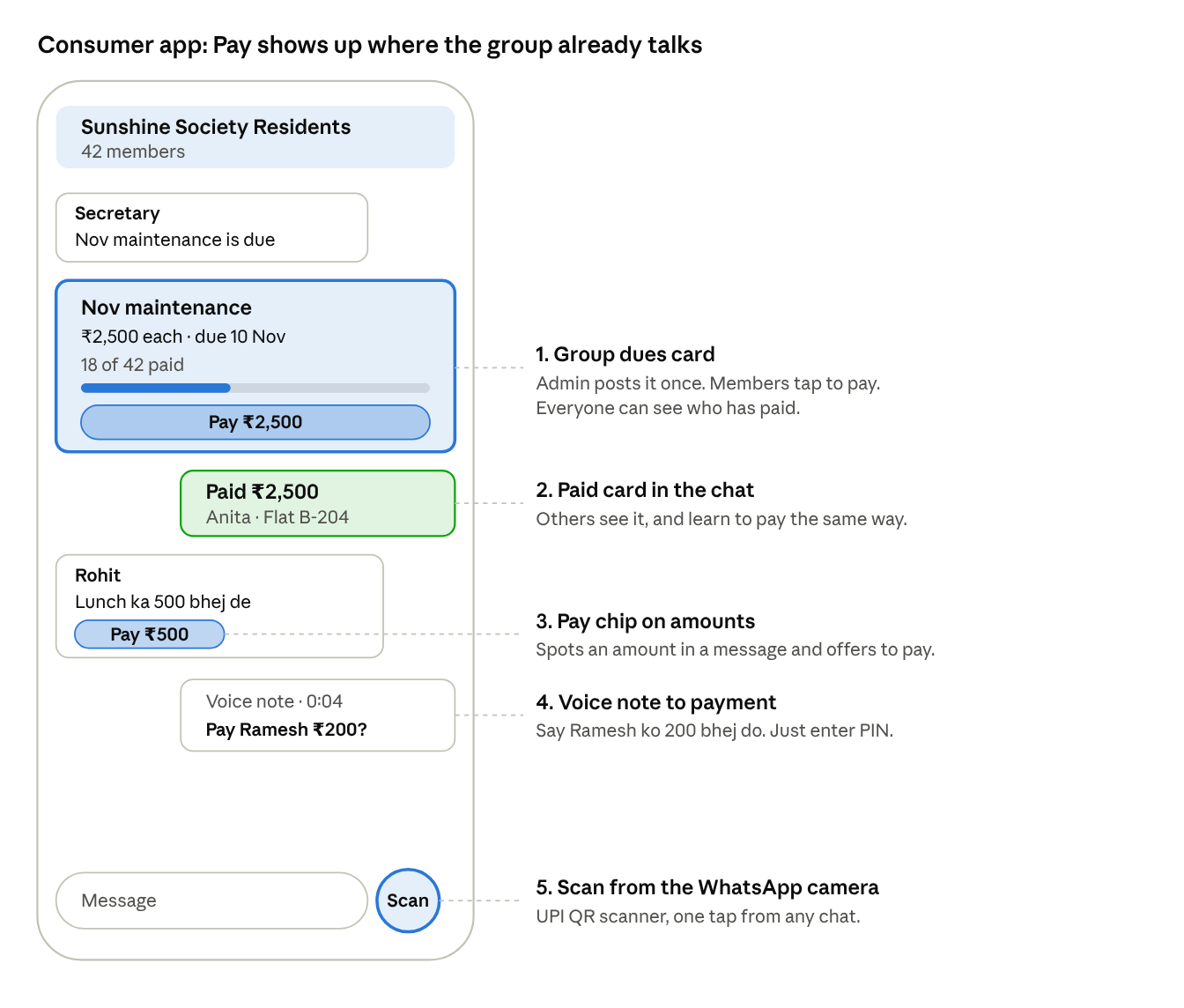
For the user, Pay sits inside the chat itself. Not behind the ₹ icon.
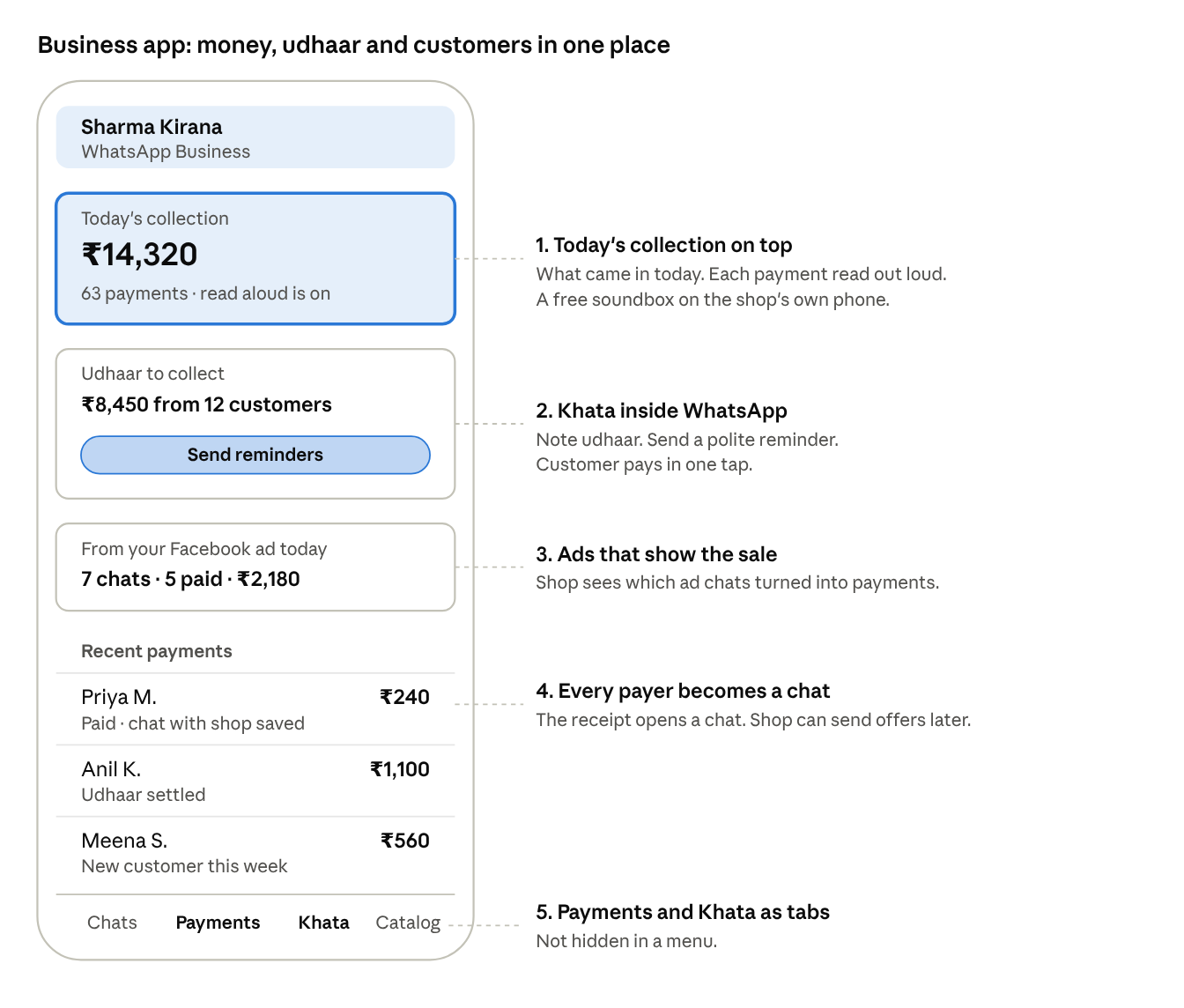
For the shop, the first screen answers three things: how much came in, who owes me and which ad worked. Numbers here are only for illustration.
What not to do
Don't get into a cashback war. Navi and super.money have shown cashback can buy share, but it doesn't last. WhatsApp's strength is that people already open it all day. Paying should feel like replying to a message. And shops should want it for reasons other than the rate.