Why you should choose CPI as your next App Marketing channel

How are you promoting your apps right now? If you are into App Marketing, you probably met different ways to grow your userbase. But which one is the best one?
There is not a single answer to this question: it depends on your goals. But if you are looking for new users, if you want to keep low their cost of acquisition and if you like performance based models… then you should take a look to CPI advertising.
What is CPI Marketing?
CPI = (Ad Spend / Total Installs)
In CPI (Cost-per-Install) campaigns, publishers place digital ads to drive installations of applications. Advertisers are charged only when their applications are installed by users that clicked on publishers’ ads.

Instead, in CPM campaigns the price depends on the number of impressions served. The payment is made after 1000 times the ad is shown to potential customers. It is usually good to increase awareness of the app, but it does not guarantee installs.
In CPC, publisher receives money every time viewers click on the ad. But a click on the ad doesn’t mean that people will install the app.
CPA is considered the price paid for specific actions completed by users, like a tutorial, a registration or a purchase. It’s a very good model to get high-quality users, but of course it’s way more expensive.
It’s easy to understand how CPI differs from other popular performance-based models for apps promotion. Advertisers pay only if an install is made by a new user, tracked by a trusted third-party tracking system and assigned to the publisher who led the installing user to the app.
Is CPI a good metric?
It depends on what you are looking for. What is certain is that you should include it in your App Marketing activity whether you are a startup, a brand, an agency, an ad network or a single developer.
Why? Because it is a meaningful metric by which you can measure your advertising budget, target valuable users, grow your audience, increase your ranking on App Store and your revenues.
CPI is more important than CPM and CPC if what you’re advertising is the app or the game itself, and not an eCommerce product. It is less expensive than a CPA approach, while you can still set soft-KPI and stop campaigns from sources that are performing bad or that are faking installs.
The average CPI
CPI can vary due to many factors: it depends on country, platform, acquisition channel, app genre and others.
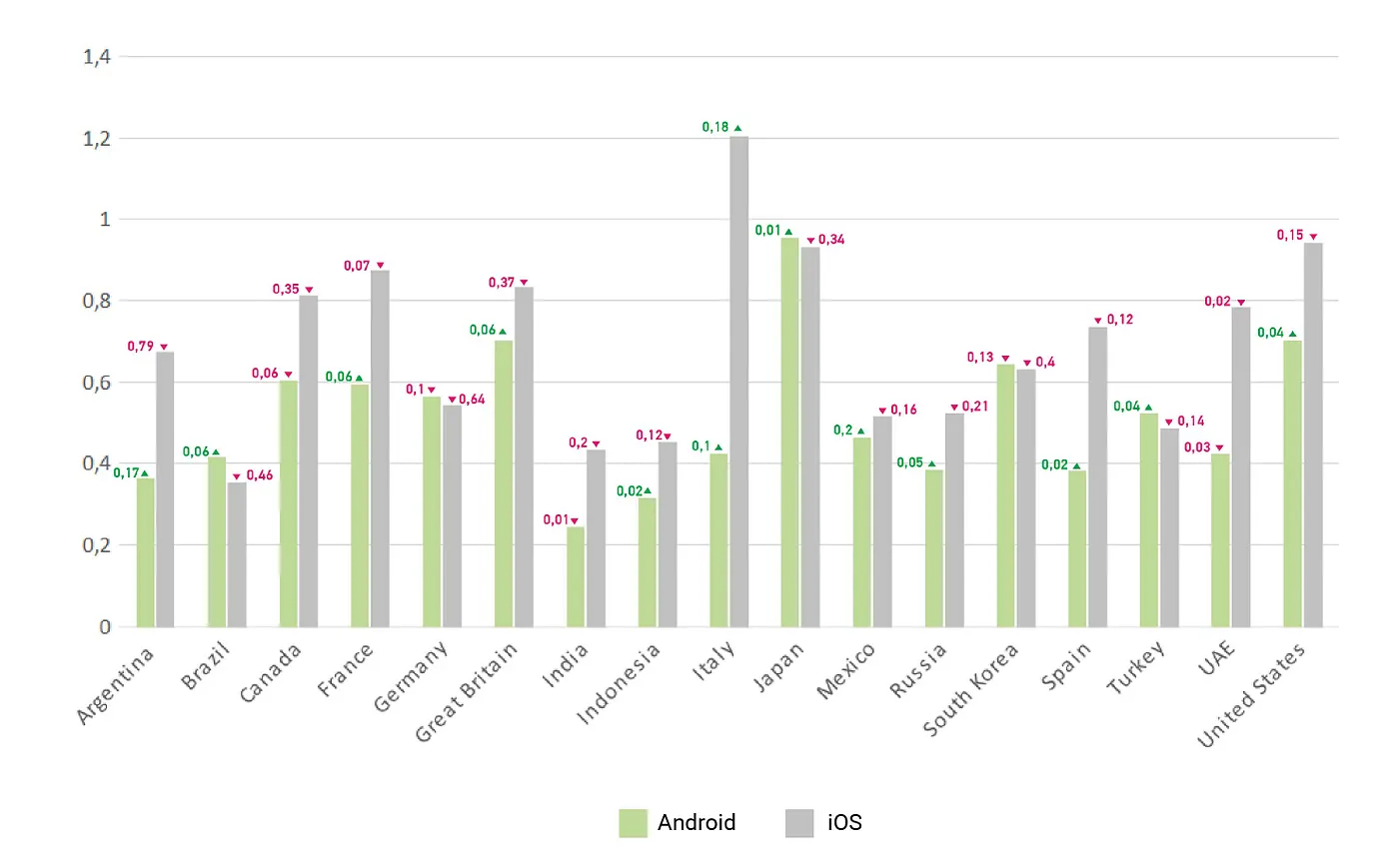
As you can see from the graph above, there is a huge difference between CPI in countries like India and US and between CPI on Android and iOS platforms. Of course, this is related to the kind of users that you are targeting: US users and iOS ones are more willing to spend than India and Android ones.

Even app genre determines the average CPI. Games have generally higher ones than Apps and there are huge differences even between subgategories.
Get Alessandro Del Grano’s stories in your inbox
Last but not least, the cost depends on the publishers/ad networks you choose and the type of their traffic (e.g. ad networks that provide incent install will have lower CPI, but you will get low quality users since they will be incentivized to make the download).
What is the best Publisher/Ad Network for CPI?
You should look at different factors when you choose your CPI providers in order to make a well-targeted and successful CPI campaign.
Direct Traffic or Rebrokered?
Always ask for the type of traffic offered. Does the provider have direct sources of traffic (e.g. apps or website managed by the publisher) or will it rebroker your offer to other partners? In the first case you can have better control in targeting, but in the second case you will have a wider scope.
Kind of Traffic? Geo?
What kind of source would fit better with your app? Does the traffic of this publisher fit with my needs? For example, if you are going to advertise an Arcade Game in Japan, you should look for publishers that have Japanese sources of traffic that vertical on games for best performances in ROI.
Incent, Non-Incent or KPI?

If you just want to raise the number of your users and rank up in App Store, you may be interested in Incent CPI campaigns. But if you are seeking for quality and ROI, you should definitetly look into Non-Incent or soft KPI ones.
Keep in mind that in Incent campaigns, users will download your app only to get a reward (such as points to get for Amazon gift cards, Google Play credits, etc.) provided by publishers, so you have to expect high drop rates.
Security and Anti-Fraud?
As you can read in my last article about fraud traffic, fake app installs are a very common plague in mobile app marketing. Check if your CPI campaign providers have an Anti-Fraud system to be sure to avoid fraud as much as possible: don’t waste your money.

Final Thoughts
I hope this story will be useful for everyone who is interested in CPI campaigns. Unfortunately, there is not a magic formula to succeed in App Marketing, but we can study each tool available on the market and decide the best strategy to push our apps on top and the best companies to partner with.
This article is meant to give you an idea of what is going on in mobile digital marketing world right now. Of course, there is much more to say and I will be glad to go in depth in my next Medium stories.
Anyway, if you want direct support on this matter just contact me on Twitter, drop me a line via email or write us at myAppFree to discover the best traffic sources.
Did you find this story useful? Follow me on Medium for more interesting posts about mobile digital marketing and app install.
One more thing…
Clap Clap Clap your hands if you want to support me!